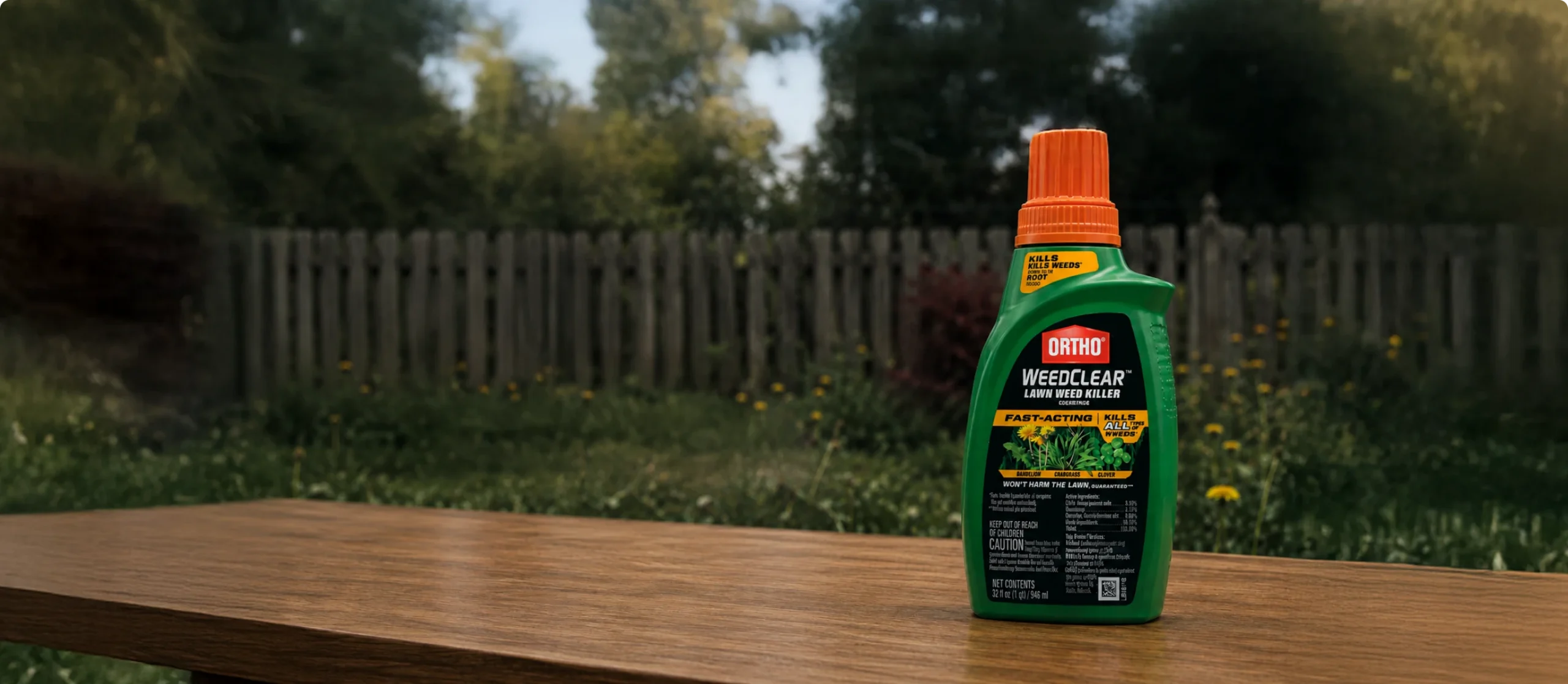
Wisner Baum is investigating Ortho Weed B Gon and other Ortho weed killers manufactured with the chemical 2,4-D (2,4-dichlorophenoxyacetic acid). Published studies have found associations between these weed killers and non-Hodgkin lymphoma (NHL), a cancer of the lymphatic system, which is the network of vessels and glands that helps the body fight infection.
This is an early-stage, emerging investigation. If you used an Ortho 2,4-D weed killer and were diagnosed with non-Hodgkin lymphoma, you may be able to pursue compensation in an Ortho Weed B Gon lawsuit.
Wisner Baum attorneys are investigating Weed B Gon weed killers made and sold under the Ortho brand by The Scotts Miracle-Gro Company. These products remain widely available to homeowners, landscapers, groundskeepers, farm workers, and others.
For decades, people have sprayed Ortho Weed B Gon on lawns and gardens, often without gloves, a mask, or any warning that the active ingredient has been flagged as a possible carcinogen by the World Health Organization’s International Agency for Research on Cancer (IARC). People who used these products and were later diagnosed with non-Hodgkin lymphoma are now asking whether the weed killer is to blame.
Call (310) 207-3233 or fill out our contact form for a free, confidential case evaluation. We take these cases on contingency, which means no attorney fees unless we win your case.
Ortho Weed B Gon Lawsuit Update
July 15, 2026: Wisner Baum is actively reviewing and accepting potential claims from people diagnosed with non-Hodgkin lymphoma after regular use of Ortho weed killers containing 2,4-D. As of July 2026, no multidistrict litigation (MDL) and no class action has been created specifically for Ortho or 2,4-D non-Hodgkin lymphoma claims. This is a developing litigation.
Do I Qualify for the Ortho Weed B Gon Lawsuit?
You may qualify to pursue an Ortho Weed B Gon claim if the following apply. A confidential review with our team is the only way to know for sure.
- Diagnosis: You have an official diagnosis of non-Hodgkin lymphoma. (This investigation is currently limited to NHL and is not reviewing other cancers at this time.)
- Exposure: You personally used an Ortho weed killer containing 2,4-D for at least 20 days per year, in at least one year. Using a product yourself is required — living near a field someone else sprayed generally does not qualify unless there was a direct personal connection to the person spraying.
- Two-year window before diagnosis: At least two years passed between your first use of an Ortho 2,4-D product and your NHL diagnosis.
- 15-year window after use: No more than 15 years passed between your last use of an Ortho 2,4-D product and your NHL diagnosis.
- Filing deadline: Your claim is still within the statute of limitations — the legal deadline to file, which varies by state and by whether the case is a personal-injury or wrongful-death claim.
If you are not sure which Ortho products you used, or whether the one you used contained 2,4-D, do not worry — our team can help you obtain records and confirm eligibility. If a loved one died from non-Hodgkin lymphoma after using these products, you may be able to bring a wrongful-death claim on their behalf.
What Is Ortho Weed B Gon
Ortho Weed B Gon is a line of lawn weed killers sold in hardware stores, garden centers, and big-box retailers across the country. The products are designed to control common lawn weeds, including dandelions, clover, crabgrass, and other broadleaf and grassy weeds. Weed B Gon is available in several formulations, including ready-to-use sprays and concentrated products.
Who Manufactures Ortho Weed B Gon?
The Ortho brand is owned by The Scotts Miracle-Gro Company, headquartered in Marysville, Ohio, which acquired the Ortho consumer lawn-and-garden business from Monsanto in 1999. The products are sold through Scotts subsidiaries, including The Scotts Company LLC and The Scotts Company doing business as The Ortho Group.
Which Ortho Weed B Gon Products Have 2,4-D?
Ortho products that have listed 2,4-D as an active ingredient include, among others:
- Ortho Weed B Gon Max / Weed B Gon Weed Killer for Lawns
- Ortho Weed B Gon Lawn Weed Killer Concentrate and Ready-to-Use formulas
- Ortho Weed B Gon Dandelion & Clover Killer for Lawns
- Ortho Weed B Gon Max Plus Crabgrass Control
- Ortho WeedClear Weed Killer for Lawns (North and South formulas, including Comfort Wand versions)
- Weed B Gon Concentrate Formula II and other legacy concentrates
What is 2,4-D?
The active weed-killing ingredient in many Ortho Weed B Gon and Ortho WeedClear products is 2,4-D, a chlorophenoxy herbicide first introduced in the 1940s. It remains one of the most widely used weed killers in North America, despite safety concerns. In Ortho formulas, 2,4-D is frequently combined with other herbicides such as mecoprop-p (MCPP-p) and dicamba.
Why People Are Bringing Ortho Weed B Gon Claims
Wisner Baum is investigating Ortho Weed B Gon claims because we believe corporations should be held accountable when they sell a product the World Health Organization's cancer agency has flagged as a possible carcinogen.
The heart of these claims is simple. Researchers began tying 2,4-D to non-Hodgkin lymphoma in the 1980s. The World Health Organization's cancer agency reviewed that research and flagged the chemical in 2015. Ortho weed killers are sold in ready-to-use bottles to homeowners who have no training, no protective equipment, and no reason to think the bottle in their garage is anything but safe.
Our attorneys are focusing on these potential allegations:
- Design defect: These products are unreasonably dangerous as designed, because the manufacturer built them around a chemical linked to cancer when safer formulations and alternatives were available.
- Negligence: The manufacturer failed to use reasonable care in testing and formulating these products and kept selling them to consumers as the research piled up.
- Negligent misrepresentation and deceptive marketing: The manufacturer promoted these products as safe for everyday home and lawn use despite risks it knew or should have known about.
Ortho Weed B Gon Litigation Status
Ortho 2,4-D non-Hodgkin lymphoma litigation is in its earliest stage. As of July 2026, there is no MDL (multidistrict litigation — a process that groups similar federal cases before one judge for efficiency) and no class action dedicated to these claims. Cases are expected to proceed as individual personal-injury lawsuits, which may later be coordinated if enough are filed.
The most closely related example to this emerging litigation is the Roundup cancer litigation, which involves a different chemical — glyphosate, not 2,4-D — but the same core question of whether a weed-killer maker should answer for a possible link to non-Hodgkin lymphoma. In the Roundup cases, juries returned some of the largest product-liability verdicts in U.S. history, and the litigation has since moved toward large-scale settlements. Wisner Baum played a central role in that fight, and we are eager to help individuals with their claims against Ortho.
Class Action vs. Mass Tort: What to Expect
People ask whether these types of cases are part of a “class action.” Ortho Weed B Gon lawsuits are individual cases that may be consolidated into a mass tort. The distinction between these two types of lawsuits is important because it affects what people can recover if their claims are successful.
In a class action, one lawsuit represents a large group with nearly identical claims, and everyone shares a single outcome. That works well for, say, a refund on a mislabeled product. It works poorly for cancer claims, because each person’s diagnosis, exposure, and losses are different.
In a mass tort, each person keeps their own individual lawsuit and their own potential recovery, even if the cases are coordinated for efficiency. Ortho 2,4-D claims are expected to follow the mass-tort model — the same model used in the Roundup litigation — so that each person’s compensation reflects their own circumstances, not an average split among thousands.
Is There an Ortho Weed B Gon Settlement?
No. There is no Ortho Weed B Gon settlement and no verdict yet because this litigation is just beginning. Anyone claiming to know what an Ortho 2,4-D case is “worth” is guessing. The value of any individual claim depends on facts that are unique to each person — the type and severity of the lymphoma, the length and intensity of 2,4-D exposure, medical costs, lost income, and more.
2,4-D and Non-Hodgkin Lymphoma: What the Science Says
The concern about 2,4-D and cancer comes from decades of published research and from the world’s leading cancer-research body.
The World Health Organization Classified 2,4-D as Possibly Carcinogenic
In 2015, the International Agency for Research on Cancer (IARC) — the cancer arm of the World Health Organization — classified 2,4-D as "possibly carcinogenic to humans" (Group 2B), publishing its full review in IARC Monographs Volume 113. The working group found strong evidence that 2,4-D causes oxidative stress — cell damage from unstable molecules — a mechanism that operates in humans, and moderate evidence that it can suppress the immune system.
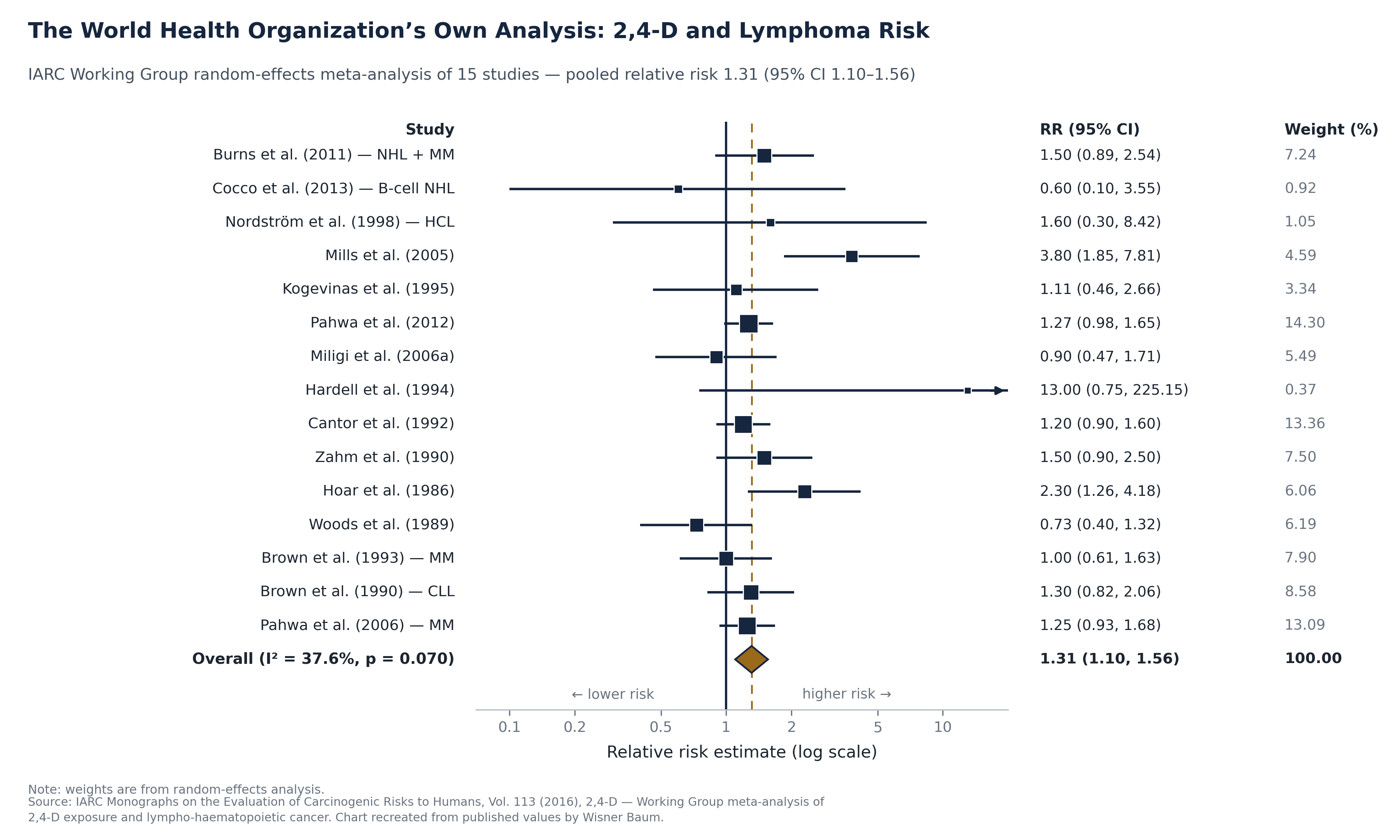
Less widely reported is what IARC's own scientists found when they pooled the human studies. Combining 15 studies of people exposed to 2,4-D, the working group calculated a 31% higher risk of lymphoma and related blood cancers — a relative risk of 1.31, with a 95 percent confidence interval of 1.10 to 1.56. Because that entire range sits above 1.0, the finding is statistically significant.
Studies Linking 2,4-D to Non-Hodgkin Lymphoma
2,4-D belongs to a family of chemicals called phenoxy herbicides. Researchers have studied this family’s link to non-Hodgkin lymphoma since the 1980s. Among the most frequently cited studies:
- Hoar et al. (1986) – A Kansas study of farm workers that found higher rates of lymphoma and soft-tissue sarcoma with agricultural herbicide use and helped launch decades of research into phenoxy herbicides and cancer.
- Zahm et al. (1990) – A population-based study of 201 men with NHL in eastern Nebraska. It found roughly a 50 percent higher rate of NHL among men who mixed or applied 2,4-D and reported that the risk climbed to more than three times normal for men who used 2,4-D 20 or more days per year.
- De Roos et al. (2003) – A pooled analysis of three U.S. National Cancer Institute case-control studies (roughly 870 NHL cases and 2,569 controls), examining multiple pesticides, including 2,4-D, as risk factors for non-Hodgkin lymphoma among men.
- McDuffie et al. (2001) – A Cross-Canada study of pesticide exposure and NHL in men, later re-analyzed by Hohenadel et al. (2011) and Pahwa et al. (2012).
Later work has continued to examine the question across larger populations, including the U.S. Agricultural Health Study, the AGRICOH pooled international cohort (Leon et al., 2019), and an InterLymph pooled analysis of occupational herbicide use across ten case-control studies (De Roos et al., 2022).
Compensation You May Be Able to Pursue in a Scotts Weed B Gon Lawsuit
People who file Scotts Weed B Gon claims may be able to seek compensation for the harm the diagnosis has caused. Depending on the case, that can include:
- Medical expenses — past and future costs of chemotherapy, hospital stays, tests, and ongoing care.
- Lost income and reduced earning capacity — wages lost during treatment and any long-term impact on the ability to work.
- Pain and suffering — the physical pain and emotional toll of the illness.
- Loss of enjoyment of life and emotional distress — hobbies, travel, and time with family that the illness takes away, and the anxiety, depression, and fear of recurrence that can follow a diagnosis.
- Wrongful death damages — for families who lost a loved one, including funeral and burial costs and loss of companionship and support.
In cases where a company’s conduct is found to be especially egregious, juries can also award punitive damages meant to punish and deter. Whether any of these apply, and in what amount, depends entirely on the facts of the individual case.
How to File a Weed B Gon Lawsuit
Getting started with your claim is simple. You do not need to have all your records in hand, and there is no cost to talk with us.
Step One: Contact Wisner Baum for a free, confidential case evaluation.
Step Two: Share what you remember — which Ortho products you used, roughly how often and for how long, and when you were diagnosed.
Step Three: Let our team help gather medical records and proof of product use.
Step Four: If you qualify and would like our attorneys to represent you, we will handle the rest. There are no up-front fees; we only get paid if we obtain compensation on your behalf.
The most important reason to act now is the statute of limitations, which is the legal deadline to file a lawsuit. It varies by state and can be shorter than people expect. Once the deadline passes, the right to file is usually gone for good.
Don’t wait to find out if you qualify. Call (310) 207-3233 today for a free, confidential review.
Why Choose Wisner Baum?
Wisner Baum has spent nearly four decades taking on powerful corporations on behalf of people who were harmed — and winning. Since the firm’s founding in 1985, its attorneys have earned more than $4 billion in verdicts and settlements, represented more than 20,000 families and clients nationwide, and tried hundreds of cases in court.
The firm’s experience is directly relevant to this emerging tort. Wisner Baum was at the forefront of the Roundup weed-killer litigation, cases raising similar questions about an allegedly harmful product linked to non-Hodgkin lymphoma.
In Pilliod v. Monsanto Company, a California jury in May 2019 ordered Monsanto to pay $2.055 billion to Alva and Alberta Pilliod, a married couple who both developed non-Hodgkin lymphoma after years of Roundup use (the court later reduced the award to $86.7 million). Wisner Baum’s managing partner, R. Brent Wisner, served as co-lead trial counsel, and attorneys Michael L. Baum and Pedram Esfandiary served on the trial team.
In an earlier case, Johnson v. Monsanto, Wisner and co-counsel helped secure a landmark verdict for a school groundskeeper with terminal non-Hodgkin lymphoma worth $289 million. The court later reduced the award to $78.5 million, and the Court of Appeal further reduced the total to $20.5 million.
Prior results do not guarantee a similar outcome in any future case — every case is different and depends on its own facts. But they show what our firm is capable of: when powerful systems fail, Wisner Baum steps in, exposes injustice, demands accountability, and fights for real results for the people who were harmed.
You do not take on any financial risk to work with us. Wisner Baum handles these cases on a contingency-fee basis, which simply means that you owe no attorney’s fees unless we are successful in obtaining compensation for you. Contact us at (310) 207-3233 to discuss your claim today.