From 1990 to 2020, eight counties in California’s Central Valley reported spraying more than 35 million pounds of chlorpyrifos, an insecticide sold as Lorsban, Dursban, and other brands. This represents roughly 65% of all chlorpyrifos spraying in the state over that 30-year period. While California ended the sale and nearly all use of chlorpyrifos in 2020, a UCLA study published in 2026 linked long-term exposure from living near sprayed fields to more than 2.5 times the risk of Parkinson’s disease.
California keeps detailed records of where pesticides are applied. Wisner Baum analyzed three decades of those state records (1990-2020) to see where chlorpyrifos was sprayed most heavily in California’s Central Valley. The answer centers on a set of farm towns many families have called home for generations: Ivanhoe, Visalia, Orange Cove, Lindsay, Reedley, McFarland, Mendota and others. If you lived or worked near these fields and were later diagnosed with Parkinson’s, you may be able to pursue a chlorpyrifos Parkinson’s lawsuit.
What is Chlorpyrifos?
Chlorpyrifos is an organophosphate insecticide used on U.S. crops since 1965 and sold under brand names including Lorsban and Dursban. In the Central Valley, it was sprayed on oranges, almonds, walnuts, cotton, grapes, and alfalfa. California ended nearly all use of it in 2020.
Chlorpyrifos Parkinson’s Disease Link
In January 2026, UCLA Health researchers published a study in Molecular Neurodegeneration comparing 829 people with Parkinson’s disease to 824 people without it. Participants came from Fresno, Kern, and Tulare counties, the same counties at the center of our analysis. Using California’s pesticide use records and participants’ home and work addresses, the researchers estimated each person’s chlorpyrifos exposure over time.
- People with long-term exposure from living near sprayed fields had more than 2.5 times the risk of developing Parkinson’s.
- In lab mice, inhaled chlorpyrifos caused movement problems and the loss of the same dopamine-producing brain cells that die in Parkinson’s.
The study’s senior author, UCLA neurology professor Dr. Jeff Bronstein, said the research “establishes chlorpyrifos as a specific environmental risk factor for Parkinson’s disease.”
For a deeper look at the research, read our breakdown of the UCLA chlorpyrifos Parkinson’s study.
How Much Chlorpyrifos was Sprayed in the Central Valley?
California requires growers to report every agricultural pesticide application to the Department of Pesticide Regulation (DPR), including the chemical, the amount and the square-mile block where it was applied. The public can search those Pesticide Use Reports through DPR’s CalPIP database.
The records show chlorpyrifos use climbed through the early 1990s, peaked in 1995 at about 2.4 million pounds, and stayed near a million pounds a year until the late 2010s. Fresno, Tulare, and Kern counties accounted for about two-thirds of the total. Use dropped sharply after 2018 as California moved to ban the chemical.
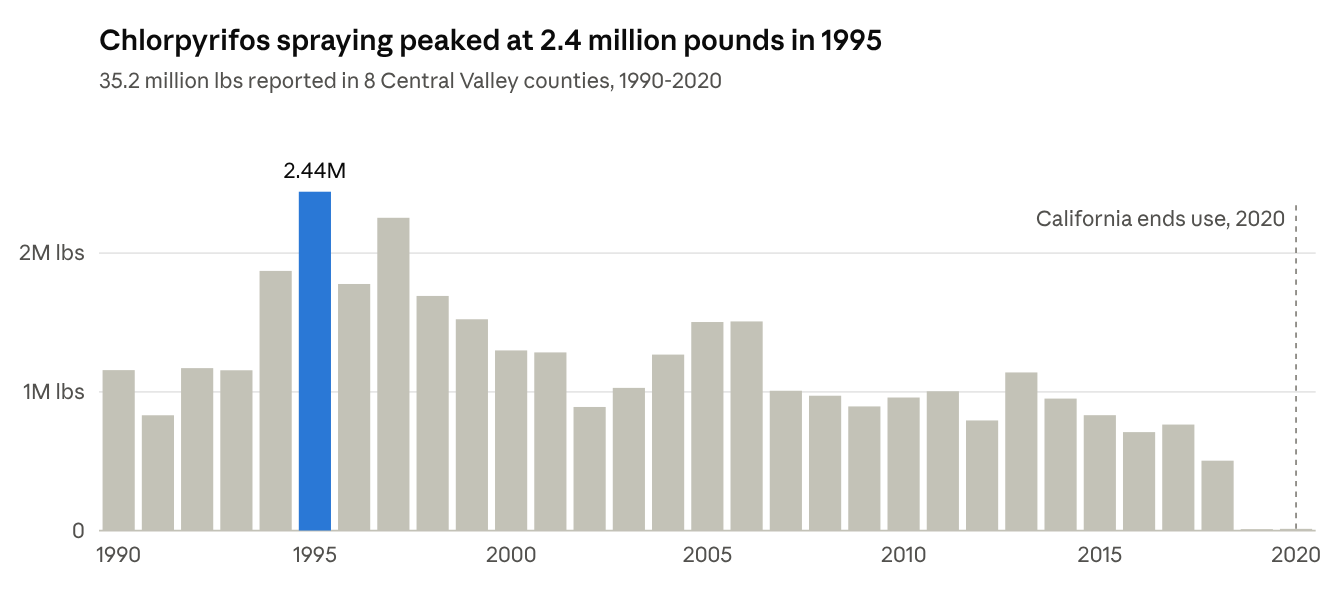
Source: California DPR Pesticide Use Reports (CalPIP) for Fresno, Kern, Kings, Madera, Merced, San Joaquin, Stanislaus and Tulare counties, 1990-2020
Which Central Valley Towns Had the Most Chlorpyrifos Spraying?
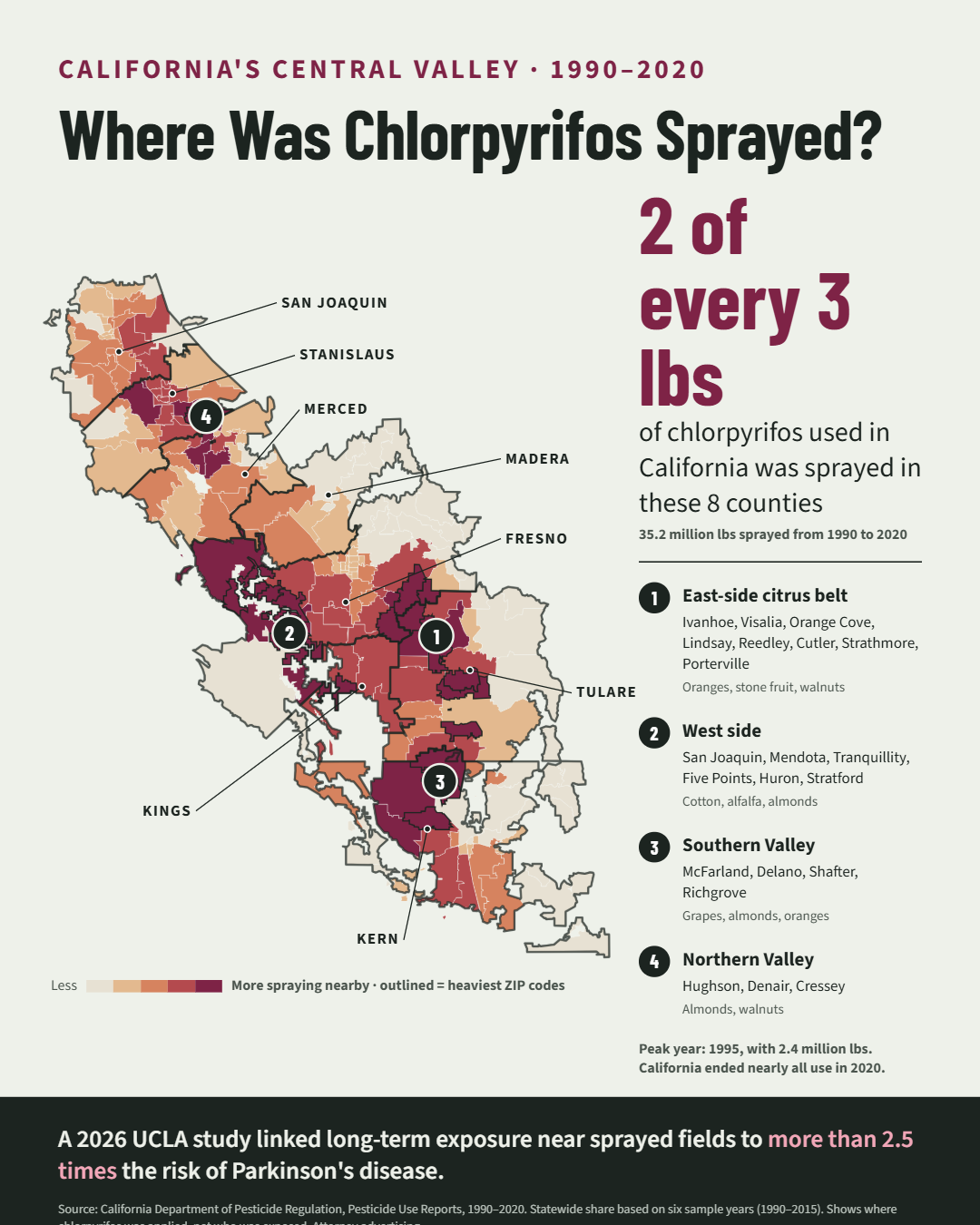
We scored every ZIP code in the eight counties by how much chlorpyrifos was sprayed on farmland within about nine miles of it, counting nearby fields more heavily than distant ones. The highest-scoring areas fall into four zones.
| Zone |
Towns with the Most Chlorpyrifos Spraying |
Main Crops |
| Eastside citrus belt (Tulare and Fresno counties) |
Ivanhoe, northeast Visalia, Orange Cove, Sultana, Cutler, Reedley, Lindsay, Strathmore, Farmersville, Dinuba, Terra Bella, Porterville, Traver, Kingsburg |
Oranges and other citrus, peaches, nectarines, plums, walnuts |
| Westside (Fresno and Kings counties) |
San Joaquin, Mendota, Tranquillity, Five Points, Huron, Stratford |
Cotton, alfalfa, almonds |
| Southern Valley (Kern and southern Tulare counties) |
McFarland, Delano, Shafter, Richgrove |
Grapes, almonds, oranges, cotton |
| Northern Valley (Stanislaus and Merced counties) |
Hughson, Denair, Cressey |
Almonds, walnuts |
The eight-county total peaked in 1995. Most citrus-belt and west-side towns saw their own peak between 1995 and 1997, when 1997 was the second-heaviest year on record. Towns in Kern and parts of Tulare and Stanislaus counties kept seeing heavy use into the 2000s and 2010s.
In the figures below, “pounds nearby” means chlorpyrifos reported on agricultural land in the square-mile survey blocks within about three miles of the town’s ZIP code, from 1990 to 2020. Figures are rounded and approximate.
Eastside Citrus Belt: Ivanhoe, Orange Cove, Lindsay, Visalia
The orange groves along the Sierra foothills, east of Highway 99, saw the heaviest spraying in the Valley. Ivanhoe ranked first, with about 419,000 pounds within 3 miles, 83% of it on oranges. Orange Cove followed with about 332,000 pounds, 91% on oranges. Lindsay (292,000 pounds), Strathmore (282,000), Reedley (282,000), Sultana (274,000) and northeast Visalia (264,000) were close behind. In Lindsay, 95% of nearby spraying was on oranges, and use peaked as early as 1992. Most of these towns saw their heaviest year in 1996 or 1997.
Westside: San Joaquin, Mendota, Tranquillity, Five Points, Huron, and Stratford
On the Valley’s west side, along Interstate 5, chlorpyrifos went mainly onto cotton. Near Five Points, cotton accounted for 89% of nearby spraying; near Stratford in Kings County, 80%. San Joaquin (about 145,000 pounds within 3 miles) and Tranquillity (144,000) had the most. Stratford had 133,000 pounds, Mendota 110,000, Huron 90,000 and Five Points 86,000. Use here was heaviest in the mid-1990s. More than two-thirds of Mendota’s nearby spraying happened before 2000.
Southern Valley: McFarland, Delano, Shafter and Richgrove
In Kern County, McFarland had about 286,000 pounds within 3 miles, the most outside the citrus belt, mainly on oranges. Richgrove, just across the Tulare County line, had 182,000 pounds. This zone stands out for how long heavy use lasted. Near Delano, where 60% of spraying was on grapes, use peaked in 2015, and only a quarter of the total came before 2000. Near Shafter, 81% went onto almonds, with a peak in 2006.
Northern Valley: Hughson, Denair and Cressey
In Stanislaus and Merced counties, chlorpyrifos was sprayed mainly in almond and walnut orchards. Hughson had about 185,000 pounds within 3 miles, nearly half on walnuts. Denair had 140,000 pounds, 84% on almonds, with a peak in 2004. Cressey, in Merced County, had about 82,000 pounds, three-quarters of it before 2000.
What About San Joaquin and Madera Counties?
Both counties are in our data, but neither has a town in the top group. Their totals were lower: about 2.1 million pounds in San Joaquin County and 1.2 million in Madera County over 31 years, compared with 9.0 million in Fresno County. Their use was also spread more thinly around towns. Their highest-ranked ZIP codes were in Stockton (49th) and Ripon (52nd) in San Joaquin County and Chowchilla (94th) in Madera County.
25 Central Valley ZIP Codes with the Most Chlorpyrifos Spraying (1990-2020)
| Rank |
ZIP Code |
Town |
County |
Lbs. Sprayed 1990–2020 |
Peak Year |
Main Crop |
| 1 |
93235 |
Ivanhoe |
Tulare |
418,785 |
1997 |
Oranges |
| 2 |
93292 |
Visalia (northeast) |
Tulare |
263,699 |
1996 |
Oranges |
| 3 |
93646 |
Orange Cove |
Fresno |
331,500 |
1997 |
Oranges |
| 4 |
93666 |
Sultana |
Tulare |
273,551 |
1997 |
Oranges |
| 5 |
93615 |
Cutler |
Tulare |
202,975 |
1997 |
Oranges |
| 6 |
93654 |
Reedley |
Fresno |
282,368 |
1996 |
Oranges |
| 7 |
93250 |
McFarland |
Kern |
286,303 |
1997 |
Oranges |
| 8 |
93247 |
Lindsay |
Tulare |
291,579 |
1992 |
Oranges |
| 9 |
93267 |
Strathmore |
Tulare |
282,265 |
1995 |
Oranges |
| 10 |
93223 |
Farmersville |
Tulare |
156,984 |
2004 |
Oranges |
| 11 |
93618 |
Dinuba |
Tulare |
120,010 |
2005 |
Oranges |
| 12 |
93270 |
Terra Bella |
Tulare |
200,236 |
1997 |
Oranges |
| 13 |
93261 |
Richgrove |
Tulare |
182,167 |
1999 |
Oranges |
| 14 |
93660 |
San Joaquin |
Fresno |
144,823 |
1996 |
Cotton |
| 15 |
93215 |
Delano |
Kern |
152,100 |
2015 |
Grapes |
| 16 |
93263 |
Shafter |
Kern |
138,924 |
2006 |
Almonds |
| 17 |
93266 |
Stratford |
Kings |
132,854 |
1995 |
Cotton |
| 18 |
93640 |
Mendota |
Fresno |
109,607 |
1997 |
Cotton |
| 19 |
93668 |
Tranquillity |
Fresno |
144,422 |
1997 |
Cotton |
| 20 |
93673 |
Traver |
Tulare |
157,094 |
2000 |
Nectarines |
| 21 |
95312 |
Cressey |
Merced |
81,625 |
1990 |
Almonds |
| 22 |
93631 |
Kingsburg |
Fresno |
153,802 |
2006 |
Peaches |
| 23 |
93624 |
Five Points |
Fresno |
86,062 |
1994 |
Cotton |
| 24 |
95316 |
Denair |
Stanislaus |
139,813 |
2004 |
Almonds |
| 25 |
93258 |
Porterville |
Tulare |
93,464 |
2006 |
Walnuts |
Who May Have Been Exposed to Chlorpyrifos?
Living in one of these towns does not mean a person was exposed, and most people exposed to chlorpyrifos will never develop Parkinson’s. But generally speaking, the data show that three groups had the most contact with the chemical:
- Farmworkers and applicators. People who mixed, loaded or sprayed chlorpyrifos, or worked in fields and orchards soon after spraying, had the most direct exposure. That exposure happened where they worked, which may be far from where they lived.
- Neighbors of treated fields. Spray drift travels beyond the field edge. The UCLA study’s findings centered on people living near treated farmland over many years.
- Long-time residents. Parkinson’s disease can take decades to develop. People who lived in these areas in the 1990s and 2000s, including those who have since moved away, are the ones whose past exposure matters most today.
Chlorpyrifos was not used only on Central Valley farms. It was also applied at commercial plant nurseries, on golf courses, and on farms across California, so people in suburban areas may have lived near spraying too.
Many people never knew the name of the chemical. They may remember the crop (oranges, almonds, cotton, grapes), the farm or labor contractor they worked for, or a product name like Lorsban or Dursban.
Our list of chlorpyrifos pesticide brands can help jog your memory. To learn why people beyond farmworkers faced exposure, see our earlier post on chlorpyrifos exposure in the Central Valley.
How the Chlorpyrifos Data Was Gathered
Wisner Baum followed these simple steps to obtain the data reported in this blog.
- CalPIP Data. We downloaded every reported agricultural chlorpyrifos application in Fresno, Kern, Kings, Madera, Merced, San Joaquin, Stanislaus, and Tulare counties from DPR’s CalPIP database, one file per year from 1990 to 2020. That is 531,655 records totaling 35.2 million pounds.
- Location. Each record lists the square-mile block (the “section” of California’s land survey grid) where chlorpyrifos was applied. We placed each block on a map using the survey grid.
- Spray index. For every ZIP code, we added up the chlorpyrifos applied on blocks within about nine miles of the ZIP code’s center, counting nearby spraying fully and distant spraying less. Spraying three miles away counts about a third as much as spraying next door. We then scaled each score so the highest ZIP code equals 100.
- Pounds within 3 miles. Separately, we added up the pounds reported on blocks within three miles of each ZIP code’s center, with no weighting.
These records show where chlorpyrifos was applied, not who was exposed or how much anyone absorbed. They cover agricultural use. About 1.2 million pounds, mostly structural pest control, had no field location and are not in the ZIP code figures. Home use of Dursban before 2001 is not included. ZIP code boundaries come from the U.S. Census Bureau.
If You Were Diagnosed with Parkinson’s After Chlorpyrifos Exposure
If you or a family member lived or worked in one of these areas and has been diagnosed with Parkinson’s disease:
- Write down where and when. List the towns, farms, employers, and years you lived or worked in the Central Valley, and the crops you remember.
- Gather medical records. Note when symptoms such as tremor, stiffness, slowed movement or balance problems began, and when you were diagnosed.
- Talk to a lawyer about your options. Wisner Baum is reviewing cases for people diagnosed with Parkinson’s after chlorpyrifos exposure. Consultations are free, and there is no fee unless we win. Call (310) 207-3233 or visit us online to learn more about filing a chlorpyrifos Parkinson’s lawsuit.