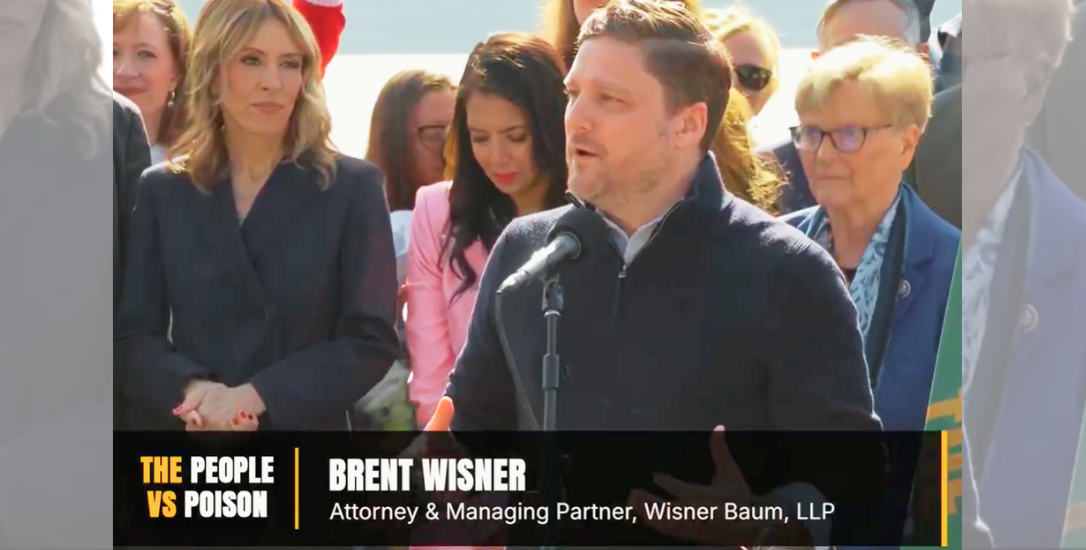
On the morning of April 27, 2026, as the nine justices of the U.S. Supreme Court took the bench to hear oral arguments in Monsanto Company v. Durnell, a crowd gathered on the steps outside. Farmers, cancer survivors, scientists, lawyers, and elected officials from both sides of the political aisle stood shoulder to shoulder at a rally called The People vs. Poison.
Wisner Baum managing partner R. Brent Wisner, the attorney who won the first-ever Roundup cancer verdict against Monsanto in 2018, was among those invited to speak at the rally. He made the trip to Washington, D.C. for a simple reason: the case heard inside the courtroom could strip Americans of one of the most fundamental protections they have against corporate negligence—the right to hold a manufacturer accountable in court when its product causes harm.
What the Supreme Court Is Deciding
The case before SCOTUS centers on John Durnell, a Missouri man who filed a lawsuit against Monsanto (now Bayer). Durnell developed non-Hodgkin lymphoma following roughly two decades of exposure to Roundup, the world’s most widely used weedkiller.
In 2023, a St. Louis jury found that Monsanto failed to adequately warn him about the risks and awarded $1.25 million in damages. The Missouri Court of Appeals affirmed the jury verdict in February 2025, and the Supreme Court agreed to take up the case in January 2026.
The justices are not deciding whether glyphosate (the active ingredient in Roundup) causes cancer. The question before the Court is narrower but carries enormous potential consequences: does the Federal Insecticide, Fungicide, and Rodenticide Act (FIFRA) override state-law failure-to-warn claims when the U.S. Environmental Protection Agency (EPA) has approved a pesticide’s label without a cancer warning?
Put more simply: can a corporation avoid accountability simply because a federal agency signed off on its product label?
Bayer, which acquired Monsanto in 2018, argues that FIFRA bars states from imposing labeling requirements that differ from federal standards, and that a jury verdict requiring a cancer warning does exactly that. Adding one unilaterally, Bayer contends, would have been illegal — the company could not change its label without EPA approval, which the agency would not grant because it has repeatedly concluded that glyphosate is “not likely carcinogenic.”
The Trump administration has sided with Monsanto, arguing through the Principal Deputy Solicitor General that states may restrict pesticide use but cannot impose labeling requirements.
The plaintiffs see it differently. Attorneys for Durnell point to the Supreme Court’s own 2005 decision in Bates v. Dow Agrosciences, which held that state failure-to-warn claims survive when they align with FIFRA’s own prohibition on selling “misbranded” pesticides. FIFRA requires uniformity in the law, plaintiffs' counsel argued, not uniformity in how different fact-finders evaluate scientific evidence.
Inside the Courtroom
During roughly 75 minutes of oral argument, several justices pushed back hard against Monsanto’s position, and not along predictable ideological lines. Justice Neil Gorsuch repeatedly pressed Monsanto’s attorney on a core inconsistency: states already possess the “greater power” to ban a pesticide outright, so why should they lack the “lesser power” to simply require a warning on the label?
Justice Ketanji Brown Jackson questioned the pace of EPA review, noting that roughly 15 years can pass between a pesticide’s initial registration and its reassessment, a gap during which significant new science can emerge. Chief Justice John Roberts raised similar concerns about whether states should alert the public to a danger while the EPA conducts its own review.
Outside the Court: Attorney R. Brent Wisner Speaks
While the justices debated statutory text, the scene outside told a more human story. The People vs. Poison rally, organized by food safety advocate Vani Hari, drew an unusual coalition. Republican Rep. Thomas Massie and Democratic Rep. Chellie Pingree stood together promoting the “No Immunity for Glyphosate Act.” Democratic Sen. Cory Booker made a surprise appearance and told the crowd that this fight transcends partisan lines.
Brent Wisner, who has spent the better part of a decade litigating Roundup cancer cases, used his time at the podium to make the stakes plain. He has described Monsanto’s objective in blunt terms: “They literally want to enshrine in law that pesticide makers are essentially immune from lawsuits provided the EPA signs off on their labeling.”
Wisner added: “It’s kind of a preposterous idea.”
He went on to emphasize that the implications extend far beyond Roundup. “Bayer and Monsanto’s efforts to basically immunize themselves from liability is something that affects all Americans,” he said. And he framed the role of civil juries as irreplaceable: “Juries serve as a check when regulators fail. These new laws take that check away.”
That message carries weight because of what Wisner has already accomplished in the courtroom. He served as co-lead trial counsel in Johnson v. Monsanto (2018), the first Roundup cancer case to reach a jury, which produced a $289 million verdict. He also co-led the Pilliod v. Monsanto trial in 2019, which resulted in a $2.055 billion verdict. Those trials, along with the Monsanto Papers Wisner and his firm de-designated and shared with lawmakers, journalists, scientists, and others, revealed that the company ghostwrote scientific articles and worked to influence regulators after the World Health Organization’s International Agency for Research on Cancer (IARC) classified glyphosate as “probably carcinogenic to humans” in 2015.
Why This Matters
Since acquiring Monsanto, Bayer has faced approximately 200,000 Roundup-related claims and has paid more than $10 billion to resolve them. Roughly 61,000 active lawsuits remain pending. In February 2026, Bayer proposed a $7.25 billion settlement to address current and future claims.
But the significance of this Supreme Court case reaches well beyond Roundup. EPA databases contain information on more than 90,000 registered pesticide products. If the Court adopts Bayer’s broad preemption theory, EPA approval could become a near-absolute liability shield for the manufacturers of every one of those products. A single ruling in a single weedkiller case could potentially insulate an entire industry from ever facing a jury.
The civil justice system exists for a reason. When a regulatory agency moves slowly, gets the science wrong, or faces political pressure to look the other way, the courtroom is where ordinary people turn to demand answers. Juries review the evidence, hear from the scientists, and reach their own conclusions. That process has worked for generations.
And now Bayer is asking the Supreme Court to shut it down.
The Bigger Picture
The Roundup litigation is the most visible front in a broader fight over whether chemical companies should be held accountable for the harm their products allegedly cause. But it is not the only one. Wisner Baum currently represents clients in cases alleging serious health effects from other widely used pesticides and herbicides, including Paraquat and Chlorpyrifos (both linked to Parkinson’s disease) and Atrazine (linked to non-Hodgkin lymphoma).
Wisner Baum: Advocacy That Extends Beyond the Courtroom
Our firm traveled to Washington because this moment could impact generations to come. If we allow corporations to buy their way out of accountability, the people who pay the price are the ones who can least afford it—the farmers, the groundskeepers, the families who trust that the products on store shelves are safe.
The Supreme Court will issue its decision next month. When it does, the country will learn whether its highest court views the jury system as a safeguard worth keeping—or an inconvenience worth discarding to benefit major corporations like Bayer.